Understanding your workspace utilization is the first step toward making informed decisions about your office layout. This guide will help you determine if your spaces are being used efficiently, or if adjustments may be needed.
Why Does Space Type Matter?
Before diving into the numbers, it's important to understand that different types of spaces serve different work needs:
|
Desks or Workstations are primarily for focused individual work (sometimes called "me space")
|
|
|
Common spaces are designed for collaboration and teamwork (sometimes called "we space")
|
Since these spaces have different purposes, we need to look at how each is being used separately to get a complete picture of your office's effectiveness.
R-Zero Connect: How do I analyse Me vs We spaces?
Understanding the Numbers
|
Peak Utilization The busiest your office gets
|
|
|
|
|
|
Average Utilization The normal day-to-day usage
|
|
Looking at both these numbers together gives you the complete picture of your office space usage.
What Good Utilization Looks Like
The Hybrid Work Model
 \
\
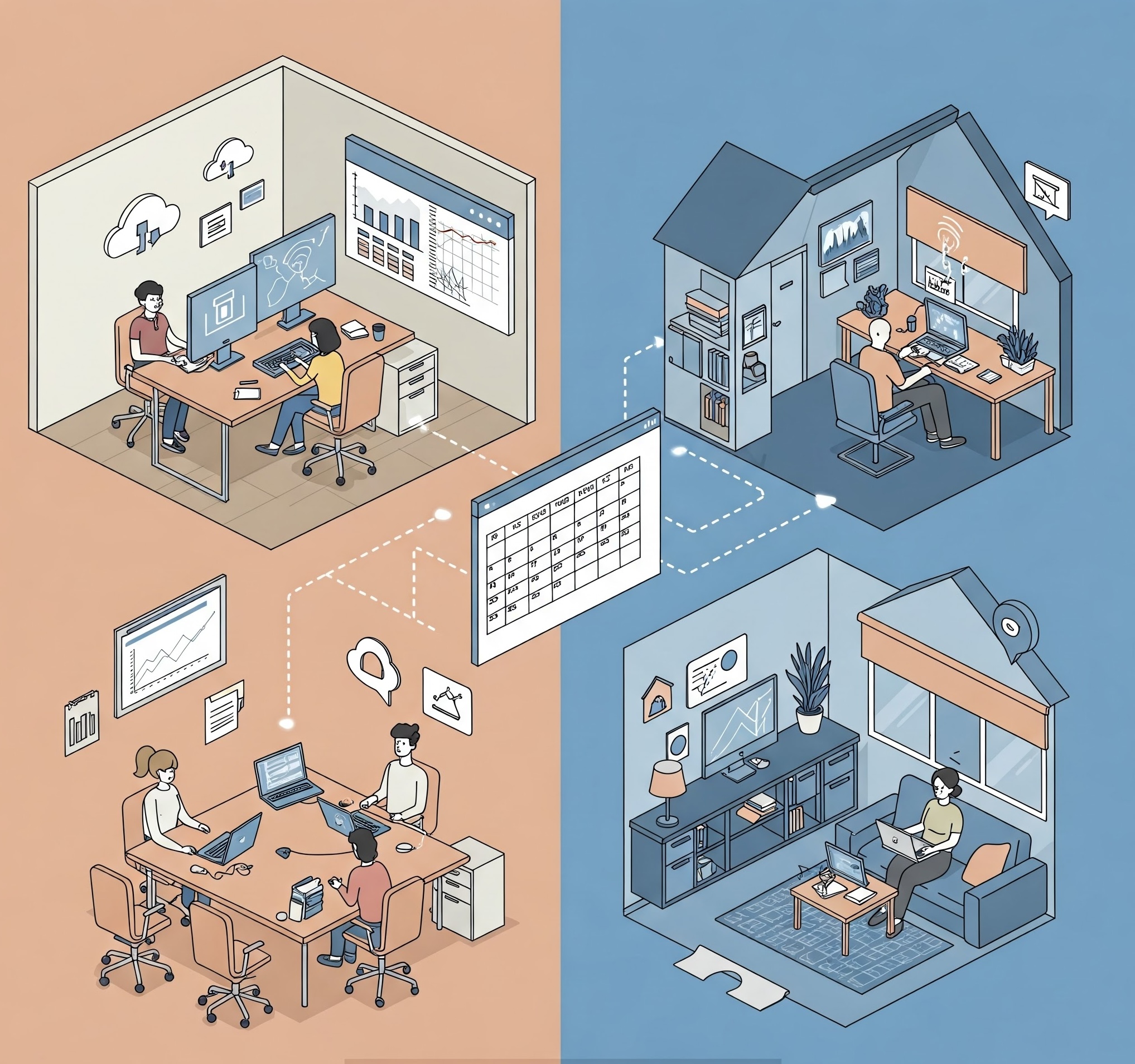
A hybrid work environment signifies a flexible model blending on-site and remote work, granting employees autonomy in choosing their work location and schedule. This approach aims to optimize productivity and employee satisfaction by balancing the benefits of in-person collaboration with the flexibility of remote work.
Me Spaces (Focus Workspaces):
- Ideal Utilization Rate: 40% - 60%.
- This range balances the need for sufficient availability for individual work while avoiding excessive underuse. Desks and private workstations should ideally be in use for at least 3-4 hours per day on average (Density Workplace Benchmark, Density 2023)
We Spaces (Collaboration Areas):
- Ideal Utilization Rate: 50% - 70%.
- Meeting rooms, collaborative hubs, and open collaboration areas should aim for higher usage, especially during mid-week peak days. Efficient use would mean these spaces are actively used for collaboration for at least 4-5 hours per day (Workplace Utilization Index: Q4 2023 & 2024 Predictions, XY Sense, 2023)
The Office-first Model
For an office-first model, the ideal occupancy metrics differ from hybrid models as there's a stronger emphasis on in-person collaboration and physical presence. Here's what companies typically consider ideal in an office-first approach:
Me Spaces (Focus Workspaces):
-
Ideal Utilization Rate: 60% - 80%. As office-first models emphasize consistent presence, higher utilization of individual desks and enclosed workstations is expected. Usage should ideally cover most of the workday, particularly between standard working hours (9 AM - 5 PM)(Adaptive Spaces: Spring 2023 U.S. Office Occupier Sentiment Survey. CBRE Research, 2023)
We Spaces (Collaboration Areas):
-
Ideal Utilization Rate: 60% - 75%.
-
High utilization of collaborative spaces is essential for an office-first model to justify the cost and design of these areas. Effective usage is generally indicated when these spaces are in active use for collaboration for at least 5 hours per day (The New Economics of Workplace Planning. Butlr Research, 2023)
Identify Your Workplace Trends
Understanding these utilization benchmarks is crucial for optimizing your office space, but how do these concepts translate to your workplace?
Now that you're familiar with the dynamics of "me" and "we" spaces, and the significance of peak versus average utilization in both hybrid and office-first models, let's turn to your data to uncover actionable insights. We can begin to identify inefficiencies and opportunities by answering key questions about your office's real-world usage:
- When is your office busiest and quietest?
- Which type of space, whether individual workstations or collaborative areas, gets used the most?
- Where do you have the most empty space, indicating potential for repurposing or downsizing?
- How is your space usage changing over time, allowing for proactive adjustments to your evolving needs?
By exploring these questions, we can translate these metrics into a tailored strategy for your workspace.